Endoscopic laser lithotripsy under cholangioscopic guidance for pediatric hepatolithiasis associated with cystic fibrosis
DOI:
https://doi.org/10.22516/25007440.1564Keywords:
Cystic fibrosis, lithiasis, endoscopy, pediatrics, adolescent, lithotripsyAbstract
Introduction: Hepatobiliary disease associated with cystic fibrosis is a progressive complication that is often difficult to manage. Within this spectrum, hepatolithiasis is an uncommon manifestation whose diagnosis and treatment are frequently delayed because of nonspecific clinical manifestations. Management has traditionally involved major surgical procedures; however, minimally invasive alternatives, such as intraductal cholangioscopy, have emerged over time for both diagnosis and treatment.
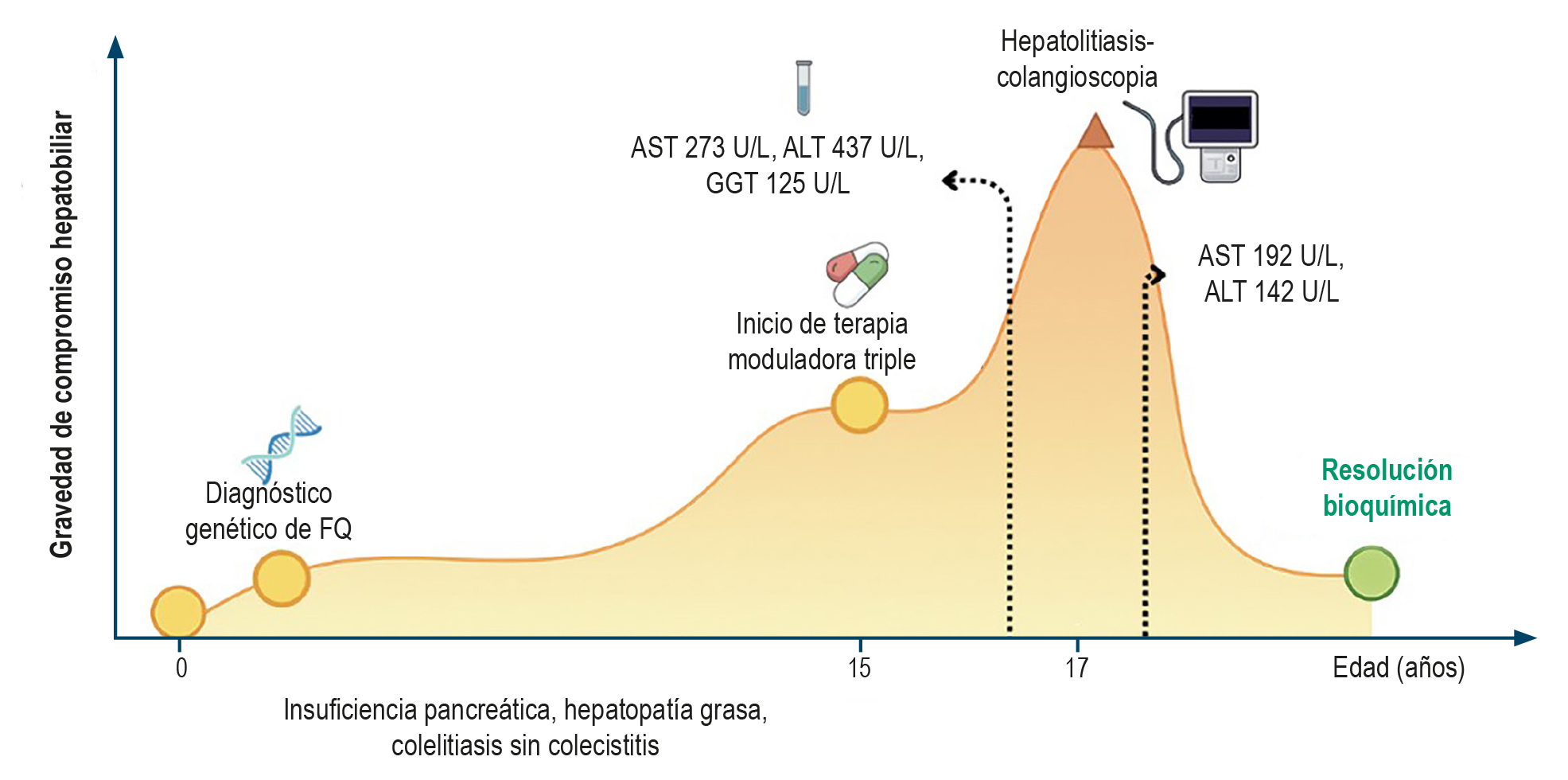
Case Report: The case of a 17-year-old adolescent girl with cystic fibrosis, pancreatic insufficiency, cystic fibrosis–related diabetes, and a history of cholelithiasis is presented. She developed progressive elevation of liver enzymes with a persistent cholestatic pattern. Magnetic resonance cholangiography identified left intrahepatic biliary stones, prompting minimally invasive endoscopic management, which enabled direct visualization and laser fragmentation of the stones.
Discussion: Hepatolithiasis in cystic fibrosis is rare and likely underdiagnosed. Its pathophysiology involves biliary stasis, ductal abnormalities, and chronic inflammation. Conventional techniques may have limitations, whereas cholangioscopy allows direct diagnosis and targeted treatment. Although its use is well established in adults, this case demonstrates its potential as an effective, minimally invasive alternative in the pediatric population.
Conclusion: Intraductal cholangioscopy with laser lithotripsy represents a promising diagnostic and therapeutic option in pediatric patients, offering an effective, minimally invasive alternative to traditionally considered surgical procedures. Its progressive incorporation into pediatric practice may optimize the management of hepatobiliary complications and contribute to preservation of liver function in patients with cystic fibrosis.
Downloads
References
Sun BZ, Sawicki GS. Advances in Care and Outcomes for Children with Cystic Fibrosis. Clin Chest Med. 2024;45(3):625-37. https://doi.org/10.1016/j.ccm.2024.03.006
Azoicai AN, Lupu A, Trandafir LM, Alexoae MM, Alecsa M, Starcea IM, et al. Cystic fibrosis management in pediatric population-from clinical features to personalized therapy. Front Pediatr. 2024;12:1393193. https://doi.org/10.3389/fped.2024.1393193
Valamparampil JJ, Gupte GL. Cystic fibrosis associated liver disease in children. WJH. 2021;13(11):1727-42. https://doi.org/10.4254/wjh.v13.i11.1727
Fiorotto R, Strazzabosco M. Pathophysiology of Cystic Fibrosis Liver Disease: A Channelopathy Leading to Alterations in Innate Immunity and in Microbiota. Cell Mol Gastroenterol Hepatol. 2019;8(2):197-207. https://doi.org/10.1016/j.jcmgh.2019.04.013
Anton-Păduraru DT, Azoicăi AN, Trofin F, Murgu AM, Mîndru DE, Bocec AS, et al. Diagnosis, Management, and Prognosis of Cystic Fibrosis-Related Liver Disease in Children. Diagnostics. 2024;14(5):538. https://doi.org/10.3390/diagnostics14050538
Barakat MT, Berquist WE, Gugig R. Cholangioscopy in Children and Adolescents: Utilization, Outcomes, and Safety. J Pediatr Gastroenterol Nutr. 2022;75(2):196-201. https://doi.org/10.1097/MPG.0000000000003499
Motta RV, Saffioti F, Mavroeidis VK. Hepatolithiasis: Epidemiology, presentation, classification and management of a complex disease. World J Gastroenterol. 2024;30(13):1836-50. https://doi.org/10.3748/wjg.v30.i13.1836
Kortbeek S, Bhandal S, Machida H, Martin SR, Galante GJ. A135 hepatolithiasis and cholangiopathy in pediatric cystic fibrosis: a case report. J Can Assoc Gastroenterol. 2020;3(Suppl 1):156–57. https://doi.org/10.1093/jcag/gwz047.134
Woodruff SA, Sontag MK, Accurso FJ, Sokol RJ, Narkewicz MR. Prevalence of elevated liver enzymes in children with cystic fibrosis diagnosed by newborn screen. J Cyst Fibros. 2017;16(1):139-45. https://doi.org/10.1016/j.jcf.2016.08.002
Manioudaki S, Vasilieva L, Geladari E, Mani I, Athanassa Z, Elefsiniotis I, et al. Improvement of Cystic Fibrosis-Associated Liver Disease in Adults on Long-Term Cystic Fibrosis Transmembrane Conductance Regulator (CFTR) Modulators. Life. 2025;15(12):1794. https://doi.org/10.3390/life15121794
Sellers ZM, Assis DN, Paranjape SM, Sathe M, Bodewes F, Bowen M, et al. Cystic fibrosis screening, evaluation, and management of hepatobiliary disease consensus recommendations. Hepatology. 2024;79(5):1220-38. https://doi.org/10.1097/HEP.0000000000000646
Dana J, Debray D, Beaufrère A, Hillaire S, Fabre M, Reinhold C, et al. Cystic fibrosis-related liver disease: Clinical presentations, diagnostic and monitoring approaches in the era of CFTR modulator therapies. J Hepatol. 2022;76(2):420-34. https://doi.org/10.1016/j.jhep.2021.09.042
Pouliopoulos P, Manika K, Faniadou E, Galanis S, Vasileiou K, Sionidou M, et al. Hepatocellular carcinoma (HCC) in a patient with cystic fibrosis and liver disease (cirrhosis). Pneumon. 2022;35(1):4. https://doi.org/10.18332/pne/145338
Perdue DG, Cass OW, Milla C, Dunitz J, Jessurun J, Sharp HL, et al. Hepatolithiasis and Cholangiocarcinoma in Cystic Fibrosis: A Case Series and Review of the Literature. Dig Dis Sci. 2007;52(10):2638-42. https://doi.org/10.1007/s10620-006-9259-1
Çakar S, Eren G, Erdur CB, Önder M, Pelek Ş, Alpdoğan S, et al. Cholelithiasis in Infants: Risk Factors, Management, and the Role of Ursodeoxycholic Acid. Children. 2024;11(12):1553. https://doi.org/10.3390/children11121553
Bass R, Brownell JN, Stallings VA. The Impact of Highly Effective CFTR Modulators on Growth and Nutrition Status. Nutrients. 2021;13(9):2907. https://doi.org/10.3390/nu13092907
Sánchez-Ocaña R, Foruny Olcina JR, Vila Costas J, Gallego Rojo F, Jiménez Pérez J, Domínguez-Muñoz E, et al. Documento de consenso de la Sociedad Española de Endoscopia Digestiva sobre SpyGlass-DS. Gastroenterología y Hepatología. 2023;46(1):69-79. https://doi.org/10.1016/j.gastrohep.2022.08.012
Flórez Sarmiento C, Parra Izquierdo V, Frías Ordóñez JS, Parga Bermúdez J, Castillo JD, Stefani Rodríguez C, et al. Experiencia en colangioscopia digital peroral con SpyGlass DS en diferentes centros de referencia en gastroenterología y endoscopia digestiva en Colombia: Serie de casos. Rev Gastroenterol Peru. 2023;42(3):177-82. https://doi.org/10.47892/rgp.2022.423.1356
Felux J, Sturm E, Busch A, Zerabruck E, Graepler F, Stüker D, et al. ERCP in infants, children and adolescents is feasible and safe: results from a tertiary care center. United European Gastroenterol J. 2017;5(7):1024-9. https://doi.org/10.1177/2050640616687868
Nakajima M, Akasaka Y, Fukumoto K, Mitsuyoshi Y, Kawai K. Peroral cholangiopancreatosocopy (PCPS) under duodenoscopic guidance. Am J Gastroenterol. 1976;66(3):241-7.
Mauro A, Mazza S, Scalvini D, Lusetti F, Bardone M, Quaretti P, et al. The Role of Cholangioscopy in Biliary Diseases. Diagnostics. 2023;13(18):2933. https://doi.org/10.3390/diagnostics13182933
Gopakumar H, Sharma NR. Role of peroral cholangioscopy and pancreatoscopy in the diagnosis and treatment of biliary and pancreatic disease: past, present, and future. Front Gastroenterol. 2023;2:1201045. https://doi.org/10.3389/fgstr.2023.1201045
Clarete A, Nasner D, Toro-Gutiérrez JS, Holguín-Holguín A. Successful application of percutaneous endoscopic cholangioscopy + electrohydraulic lithotripsy for hepatolithiasis post-liver transplantation: a case report. J Med Case Reports. 2024;18(1):472. https://doi.org/10.1186/s13256-024-04669-y
Khizar H, Gu W, Zhou H, Yang J, Jin H, He X, et al. A comparative study of extracorporeal shock wave lithotripsy and cholangioscopy-guided lithotripsy in the management of complex biliary stones: A randomized trial. J Trauma Acute Care Surg. 2025;99(4):628-34. https://doi.org/10.1097/TA.0000000000004693
Downloads
Published
How to Cite
Issue
Section
License
Copyright (c) 2026 Revista colombiana de Gastroenterología

This work is licensed under a Creative Commons Attribution-NonCommercial-NoDerivatives 4.0 International License.
Aquellos autores/as que tengan publicaciones con esta revista, aceptan los términos siguientes:
Los autores/as ceden sus derechos de autor y garantizarán a la revista el derecho de primera publicación de su obra, el cuál estará simultáneamente sujeto a la Licencia de reconocimiento de Creative Commons que permite a terceros compartir la obra siempre que se indique su autor y su primera publicación en esta revista.
Los contenidos están protegidos bajo una licencia de Creative Commons Reconocimiento-NoComercial-SinObraDerivada 4.0 Internacional.


| Article metrics | |
|---|---|
| Abstract views | 0 |
| Galley views | 0 |
| PDF Views | 0 |
| HTML views | 0 |
| Other views | 0 |