Trastornos de la vesícula biliar y del esfínter de Oddi: ¿Qué cambia con Roma V y por qué importa en Latinoamérica?
DOI:
https://doi.org/10.22516/25007440.1654Palabras clave:
Vesícula biliar, Esfínter de Oddi, Pancreatitis biliar, Colecistectomía, Colangiopancreatografía endoscópicaResumen
Introducción: el trastorno vesicular disfuncional y el trastorno del esfínter de Oddi son referencias del dolor abdominal superior, obstrucción biliar o pancreatitis sin causa estructural u orgánica evidente. Su diagnóstico se definía a través de la colescintigrafía y la manometría del esfínter, pruebas que son de baja reproducibilidad y que favorecieron el sobrediagnóstico y el uso excesivo de colecistectomía y colangiopancreatografía retrógrada endoscópica.
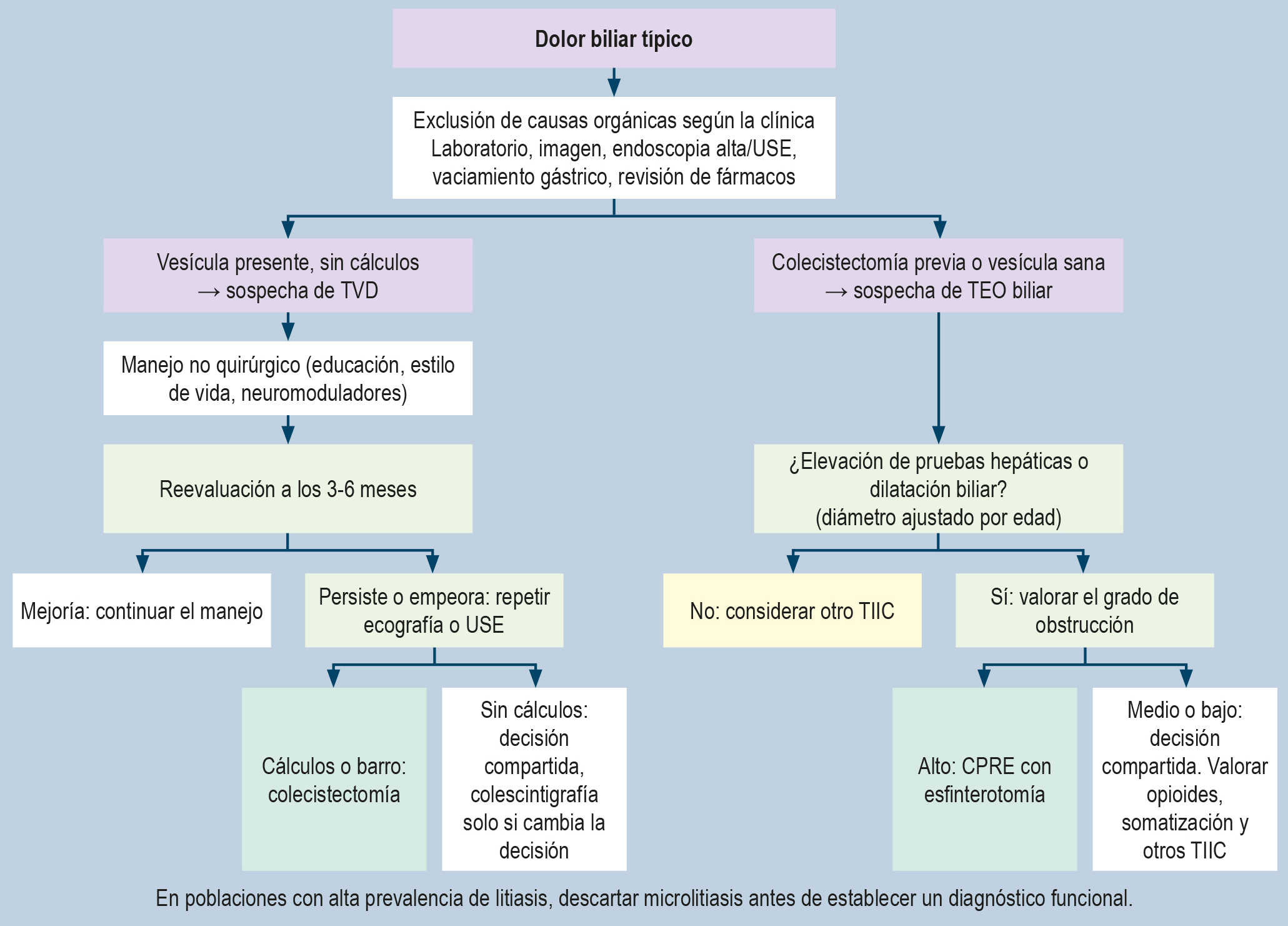
Resultados: se revisaron los cambios de Roma V, que constituyen una definición más estricta del dolor biliar típico; la exclusión de la fracción de eyección vesicular y la incorporación de un período de observación en el trastorno vesicular disfuncional; el abandono de la clasificación de Milwaukee, la manometría y la gammagrafía en el trastorno del esfínter de Oddi biliar, que ahora exige evidencia objetiva de obstrucción, y la restricción del trastorno del esfínter de Oddi pancreático a la pancreatitis aguda recurrente idiopática. Se incorporaron las implicaciones para Latinoamérica, donde la colelitiasis alcanza prevalencias de 27% al 35%, y donde la colecistectomía es muy frecuente y la región andina concentra las mayores tasas de cáncer de vesícula del mundo.
Conclusiones: Roma V consolida un enfoque restrictivo que prioriza el dolor biliar típico y la evidencia objetiva de obstrucción para indicar intervenciones. En nuestra región, su aplicación exige descartar rigurosamente la microlitiasis y otras causas estructurales, como malignidad, y de esa manera evitar procedimientos invasivos en pacientes con otros trastornos de la interacción intestino-cerebro.
Descargas
Referencias bibliográficas
Elmunzer BJ, Winslow E, De Giorgio R, Laghi A, Arvanitakis M, Elta G, et al. Gallbladder and sphincter of Oddi disorders. Gastroenterology. 2026;170(6):1303-17. https://doi.org/10.1053/j.gastro.2026.01.035
Cotton PB, Elta GH, Carter CR, Pasricha PJ, Corazziari ES. Rome IV. Gallbladder and sphincter of Oddi disorders. Gastroenterology. 2016;150(4):1420-9. https://doi.org/10.1053/j.gastro.2016.02.033
Cotton PB, Durkalski V, Romagnuolo J, Pauls Q, Fogel E, Tarnasky P, et al. Effect of endoscopic sphincterotomy for suspected sphincter of Oddi dysfunction on pain-related disability following cholecystectomy: the EPISOD randomized clinical trial. JAMA. 2014;311(20):2101-9. https://doi.org/10.1001/jama.2014.5220
Miquel JF, Covarrubias C, Villaroel L, Mingrone G, Greco AV, Puglielli L, et al. Genetic epidemiology of cholesterol cholelithiasis among Chilean Hispanics, Amerindians, and Maoris. Gastroenterology. 1998;115(4):937-46. https://doi.org/10.1016/S0016-5085(98)70266-5
Stinton LM, Shaffer EA. Epidemiology of gallbladder disease: cholelithiasis and cancer. Gut Liver. 2012;6(2):172-87. https://doi.org/10.5009/gnl.2012.6.2.172
Lammert F, Gurusamy K, Ko CW, Miquel JF, Méndez-Sánchez N, Portincasa P, et al. Gallstones. Nat Rev Dis Primers. 2016;2:16024. https://doi.org/10.1038/nrdp.2016.24
Salazar M, Ituarte C, Abriata MG, Santoro F, Arroyo G. Gallbladder cancer in South America: epidemiology and prevention. Chin Clin Oncol. 2019;8:32. https://doi.org/10.21037/cco.2019.07.12
Andia ME, Hsing AW, Andreotti G, Ferreccio C. Geographic variation of gallbladder cancer mortality and risk factors in Chile: a population-based ecologic study. Int J Cancer. 2008;123(3):1411-6. https://doi.org/10.1002/ijc.23662
Doran FS. The sites to which pain is referred from the common bile-duct in man and its implication for the theory of referred pain. Br J Surg. 1967;54(7):599-606. https://doi.org/10.1002/bjs.1800540708
Bielefeldt K, Saligram S, Zickmund SL, Dudekula A, Olyaee M, Yadav D, et al. Cholecystectomy for biliary dyskinesia: how did we get there? Dig Dis Sci. 2014;59(12):2850-63. https://doi.org/10.1007/s10620-014-3342-9
Kaye AJ, Jatla M, Mattei P, Kelly J, Nance ML. Use of laparoscopic cholecystectomy for biliary dyskinesia in the child. J Pediatr Surg. 2008;43(6):1057-9. https://doi.org/10.1016/j.jpedsurg.2008.02.034
Preston JF, Diggs BS, Dolan JP, Gilbert EW, Schein M, Hunter JG, et al. Biliary dyskinesia: a surgical disease rarely found outside the United States. Am J Surg. 2015;209(4):799-803. https://doi.org/10.1016/j.amjsurg.2015.01.003
Sperber AD, Bangdiwala SI, Drossman DA, Ghoshal UC, Simren M, Tack J, et al. Worldwide prevalence and burden of functional gastrointestinal disorders, results of Rome Foundation Global Study. Gastroenterology. 2021;160(1):99-114.e3. https://doi.org/10.1053/j.gastro.2020.04.014
DiBaise JK, Oleynikov D. Does gallbladder ejection fraction predict outcome after cholecystectomy for suspected chronic acalculous gallbladder dysfunction? A systematic review. Am J Gastroenterol. 2003;98(12):2605-11. https://doi.org/10.1111/j.1572-0241.2003.08772.x
Rose JB, Fields RC, Strasberg SM. Poor reproducibility of gallbladder ejection fraction by biliary scintigraphy for diagnosis of biliary dyskinesia. J Am Coll Surg. 2018;226(2):155-9. https://doi.org/10.1016/j.jamcollsurg.2017.10.025
Alhayo S, Eslick GD, Cox MR. Cholescintigraphy may have a role in selecting patients with biliary dyskinesia for cholecystectomy: a systematic review. ANZ J Surg. 2020;90(9):1647-52. https://doi.org/10.1111/ans.16003
Gudsoorkar VS, Oglat A, Jain A, Raza A, Quigley EMM. Systematic review with meta-analysis: cholecystectomy for biliary dyskinesia-what can the gallbladder ejection fraction tell us? Aliment Pharmacol Ther. 2019;49(6):654-63. https://doi.org/10.1111/apt.15128
Carr JA, Walls J, Bryan LJ, Snider DL. The treatment of gallbladder dyskinesia based upon symptoms: results of a 2-year, prospective, nonrandomized, concurrent cohort study. Surg Laparosc Endosc Percutan Tech. 2009;19(3):222-6. https://doi.org/10.1097/SLE.0b013e3181a74690
Vetrhus M, Berhane T, Soreide O, Søndenaa K. Pain persists in many patients five years after removal of the gallbladder: observations from two randomized controlled trials of symptomatic, noncomplicated gallstone disease and acute cholecystitis. J Gastrointest Surg. 2005;9(6):826-31. https://doi.org/10.1016/j.gassur.2005.01.291
Isherwood J, Oakland K, Khanna A. A systematic review of the aetiology and management of post cholecystectomy syndrome. Surgeon. 2019;17(1):33-42. https://doi.org/10.1016/j.surge.2018.04.001
Smith ZL, Shah R, Elmunzer BJ, Chak A. The next EPISOD: trends in utilization of endoscopic sphincterotomy for sphincter of Oddi dysfunction from 2010-2019. Clin Gastroenterol Hepatol. 2022;20:e600-9. https://doi.org/10.1016/j.cgh.2020.11.008
Pasricha PJ. Unraveling the mystery of pain in chronic pancreatitis. Nat Rev Gastroenterol Hepatol. 2012;9(3):140-51. https://doi.org/10.1038/nrgastro.2011.274
Côté GA, Elmunzer BJ, Nitchie H, Kwon RS, Willingham FF, Wani S, et al. Sphincterotomy for biliary sphincter of Oddi disorder and idiopathic acute recurrent pancreatitis: the RESPOnD longitudinal cohort. Gut. 2024;74(1):58-66. https://doi.org/10.1136/gutjnl-2024-332686
Freeman ML, Gill M, Overby C, Cen YY. Predictors of outcomes after biliary and pancreatic sphincterotomy for sphincter of Oddi dysfunction. J Clin Gastroenterol. 2007;41(1):94-102. https://doi.org/10.1097/01.mcg.0000225584.40212.fb
Côté GA, Nitchie H, Elmunzer BJ, Kwon RS, Willingham FF, Wani S, et al. Characteristics of patients undergoing endoscopic retrograde cholangiopancreatography for sphincter of Oddi disorders. Clin Gastroenterol Hepatol. 2022;20:e627-34. https://doi.org/10.1016/j.cgh.2021.03.008
Suarez AL, Pauls Q, Durkalski-Mauldin V, Cotton PB. Sphincter of Oddi manometry: reproducibility of measurements and effect of sphincterotomy in the EPISOD study. J Neurogastroenterol Motil. 2016;22(3):477-82. https://doi.org/10.5056/jnm15123
Beyer G, Kasprowicz F, Hannemann A, Aghdassi A, Thamm P, Völzke H, et al. Definition of age-dependent reference values for the diameter of the common bile duct and pancreatic duct on MRCP: a population-based, cross-sectional cohort study. Gut. 2023;72(9):1738-44. https://doi.org/10.1136/gutjnl-2021-326106
Pauls Q, Durkalski-Mauldin V, Brawman-Mintzer O, Lawrence C, Whichard R, Cotton PB. Duloxetine for the treatment of patients with suspected sphincter of Oddi dysfunction: a pilot study. Dig Dis Sci. 2016;61(9):2704-9. https://doi.org/10.1007/s10620-016-4187-1
Banks PA, Bollen TL, Dervenis C, Gooszen HG, Johnson CD, Sarr MG, et al. Classification of acute pancreatitis-2012: revision of the Atlanta classification and definitions by international consensus. Gut. 2013;62(1):102-11. https://doi.org/10.1136/gutjnl-2012-302779
Strand DS, Law RJ, Yang D, Elmunzer BJ. AGA clinical practice update on the endoscopic approach to recurrent acute and chronic pancreatitis: expert review. Gastroenterology. 2022;163(4):1107-14. https://doi.org/10.1053/j.gastro.2022.07.079
Vila JJ, Mendioroz FJJ, Yeaton P, Fernández-Urién I, García Sanchotena JL, Goñi S. EUS is superior to secretin-enhanced cholangio-MRI to establish the etiology of idiopathic acute pancreatitis. Endosc Int Open. 2020;8(10):E1441-7. https://doi.org/10.1055/a-1233-1849
Côté GA, Durkalski-Mauldin V, Fogel EL, Moffatt DC, Freeman ML, Wang AY, et al. 987a: minor papilla sphincterotomy does not reduce the risk of acute pancreatitis in patients with acute recurrent pancreatitis and pancreas divisum: the SHARP trial. Gastroenterology. 2025;169(1):S-2083-S-2084. https://doi.org/10.1016/S0016-5085(25)05721-X
Côté GA, Imperiale TF, Schmidt SE, Fogel E, Lehman G, McHenry L, et al. Similar efficacies of biliary, with or without pancreatic, sphincterotomy in treatment of idiopathic recurrent acute pancreatitis. Gastroenterology. 2012;143(6):1502-9.e1. https://doi.org/10.1053/j.gastro.2012.09.006
Descargas
Publicado
Cómo citar
Número
Sección
Licencia
Derechos de autor 2026 Revista colombiana de Gastroenterología

Esta obra está bajo una licencia internacional Creative Commons Atribución-NoComercial-SinDerivadas 4.0.
Aquellos autores/as que tengan publicaciones con esta revista, aceptan los términos siguientes:
Los autores/as ceden sus derechos de autor y garantizarán a la revista el derecho de primera publicación de su obra, el cuál estará simultáneamente sujeto a la Licencia de reconocimiento de Creative Commons que permite a terceros compartir la obra siempre que se indique su autor y su primera publicación en esta revista.
Los contenidos están protegidos bajo una licencia de Creative Commons Reconocimiento-NoComercial-SinObraDerivada 4.0 Internacional.


| Estadísticas de artículo | |
|---|---|
| Vistas de resúmenes | 0 |
| Vistas de PDF | 0 |
| Descargas de PDF | 0 |
| Vistas de HTML | 0 |
| Otras vistas | 0 |