Characterization of Patients with Lactose Intolerance at a Gastroenterology Diagnostic Center
DOI:
https://doi.org/10.22516/25007440.1184Keywords:
Lactose intolerance, Irritable bowel syndrome, Diarrhea, abdominal painAbstract
Introduction: The estimated global prevalence of lactose intolerance is 68%, while in Colombia, it reaches up to 59%. Primary lactase deficiency is the most common cause of lactose intolerance and malabsorption in adults. The lactose hydrogen breath test (HBT) is a routinely used diagnostic tool for this condition.
Methodology: All lactose hydrogen breath tests (HBTs) conducted between August 2020 and September 2023 at the Gastropack medical center in Cartagena were reviewed. These tests were performed on patients presenting with symptoms such as abdominal pain, bloating, and diarrhea during gastroenterology consultations. Medical records were analyzed, and all clinical and sociodemographic variables were documented to characterize the population with lactose intolerance.
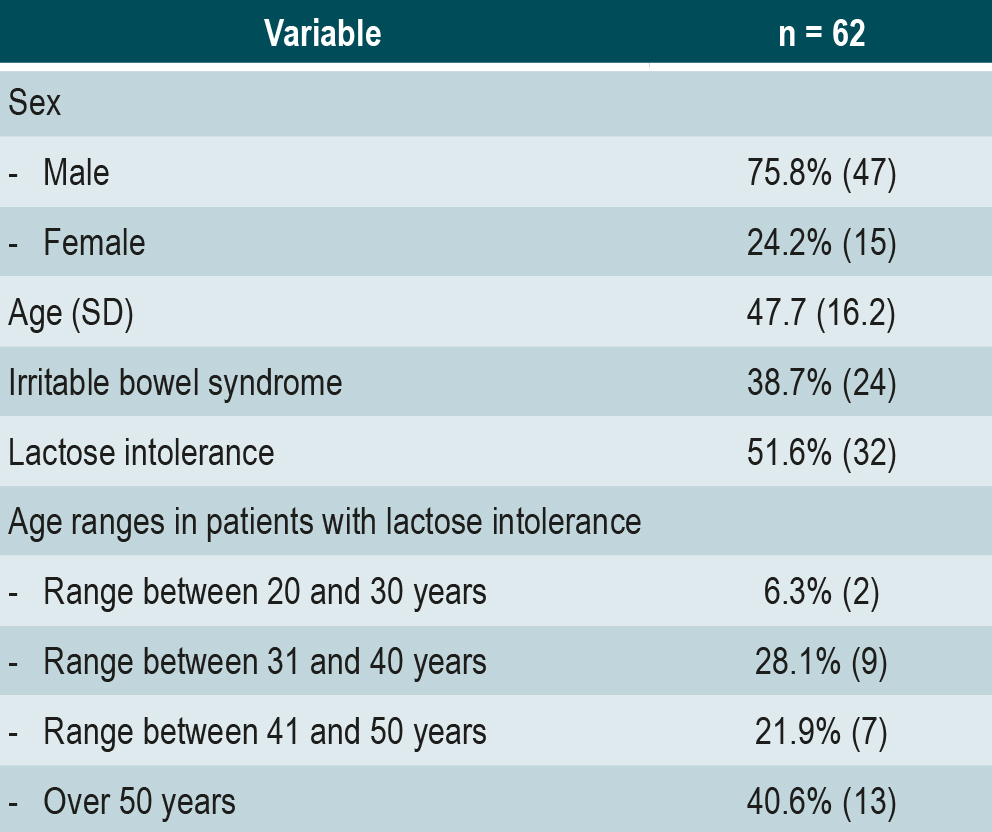
Results: Out of 397 hydrogen breath tests performed between August 2020 and September 2023, 62 were identified as lactose HBTs. Of these, 24.4% were female patients, with an average age of 47 years. The most common symptoms included abdominal pain (71%), bloating (66.1%), diarrhea (30%), and flatulence (29%). Additionally, 38.7% of patients had a prior diagnosis of irritable bowel syndrome (IBS). Overall, 51.6% of the tests were positive for lactose intolerance. Among IBS patients, 44% tested positive for lactose intolerance. No statistically significant differences were found between patients with and without lactose intolerance.
Conclusion: This study did not identify specific factors associated with lactose intolerance. Although the sample size was relatively small, performing lactose hydrogen breath tests is recommended in patients with suggestive symptoms and in those with conditions that share similar symptoms, such as IBS. This approach can help prevent unnecessary dietary restrictions that may negatively impact patients’ quality of life and nutritional status.
Downloads
References
Misselwitz B, Butter M, Verbeke K, Fox MR. Update on lactose malabsorption and intolerance: pathogenesis, diagnosis and clinical management. Gut. 2019;68(11):2080-2091. https://doi.org/10.1136/gutjnl-2019-318404
Catanzaro R, Sciuto M, Marotta F. Lactose Intolerance—Old and New Knowledge on Pathophysiological Mechanisms, Diagnosis, and Treatment. SN Comprehensive Clinical Medicine. 2021;3(2):499-509. https://doi.org/10.1007/s42399-021-00792-9
Deng Y, Misselwitz B, Dai N, Fox M. Lactose Intolerance in Adults: Biological Mechanism and Dietary Management. Nutrients. 2015;7(9):8020-35. https://doi.org/10.3390/nu7095380
Storhaug CL, Fosse SK, Fadnes LT. Country, regional, and global estimates for lactose malabsorption in adults: a systematic review and meta-analysis. Lancet Gastroenterol Hepatol. 2017;2(10):738-746. https://doi.org/10.1016/S2468-1253(17)30154-1
Ángel LA, Calvo E, Muñoz Y. Prevalencia de hipolactasia tipo adulto e intolerancia a la lactosa en adultos jóvenes. Rev Colomb Gastroenterol. 2005;20(4):35-47.
Mendoza Torres E, Varela Prieto LL, Villarreal Camacho JL, Villanueva Torregroza DA. Diagnosis of adult-type hypolactasia/lactase persistence: genotyping of single nucleotide polymorphism (SNP C/T-13910) is not consistent with breath test in Colombian Caribbean population. Arquivos de Gastroenterologia. 2012;49:5-8. https://doi.org/10.1590/S0004-28032012000100002
Santonocito C, Scapaticci M, Guarino D, Annicchiarico EB, Lisci R, Penitente R, et al. Lactose intolerance genetic testing: Is it useful as routine screening? Results on 1426 south-central Italy patients. Clinica Chimica Acta. 2015;439:14-7. https://doi.org/10.1016/j.cca.2014.09.026
Schiffner R, Kostev K, Gothe H. Do patients with lactose intolerance exhibit more frequent comorbidities than patients without lactose intolerance? An analysis of routine data from german medical practices. Ann Gastroenterol. 2016;29(2):174-9. https://doi.org/10.20524/aog.2016.0009
Böhmer CJ, Tuynman HA. The effect of a lactose-restricted diet in patients with a positive lactose tolerance test, earlier diagnosed as irritable bowel syndrome: a 5-year follow-up study. Eur J Gastroenterol Hepatol. 2001;13(8):941-944. https://doi.org/10.1097/00042737-200108000-00011
Catanzaro R, Sciuto M, Singh B, Pathak S, Marotta F. Irritable bowel syndrome and lactose intolerance: the importance of differential diagnosis. A monocentric study. Minerva Gastroenterol (Torino). 2021;67(1):72-78. https://doi.org/10.23736/S2724-5985.20.02734-8
Farup PG, Monsbakken KW, Vandvik PO. Lactose malabsorption in a population with irritable bowel syndrome: prevalence and symptoms. A case-control-study. Scand J Gastroenterol. 2004;39(7):645-9. https://doi.org/10.1080/00365520410005405
Nucera G, Gabrielli M, Lupascu A, Lauritano EC, Santoliquido A, Cremonini F, et al. Abnormal breath tests to lactose, fructose and sorbitol in irritable bowel syndrome may be explained by small intestinal bacterial overgrowth. Aliment Pharmacol Ther. 2005;21(11):1391-5. https://doi.org/10.1111/j.1365-2036.2005.02493.x
Montalto M, Curigliano V, Santoro L, Vastola M, Cammarota G, Manna R, et al. Management and treatment of lactose malabsorption. World J Gastroenterol. 2006;12(2):187-91. https://doi.org/10.3748/wjg.v12.i2.187
Jellema P, Schellevis FG, van der Windt DA, Kneepkens CM, van der Horst HE. Lactose malabsorption and intolerance: a systematic review on the diagnostic value of gastrointestinal symptoms and self-reported milk intolerance. QJM. 2010;103(8):555-72. https://doi.org/10.1093/qjmed/hcq082
Dennis Savaiano D. Lactose intolerance: a self-fulfilling prophecy leading to osteoporosis?. Review Nutr Rev. 2003;61(6 Pt 1):221-3. https://doi.org/10.1301/nr.2003.jun.221-223
Arola H. Diagnosis of hypolactasia and lactose malabsorption. Scand J Gastroenterol Suppl. 1994;202:26-35. https://doi.org/10.3109/00365529409091742
Di Stefano M, Veneto G, Malservisi S, Cecchetti L, Minguzzi L, Strocchi A, et al. Lactose malabsorption and intolerance and peak bone mass. Gastroenterology. 2002;122(7):1793-9. https://doi.org/10.1053/gast.2002.33600
Lanou AJ, Berkow SE, Barnard ND. Calcium, dairy products, and bone health in children and young adults: a reevaluation of the evidence. Pediatrics. 2005;115(3):736-43. https://doi.org/10.1542/peds.2004-0548
Black RE, Williams SM, Jones IE, Goulding A. Children who avoid drinking cow milk have low dietary calcium intakes and poor bone health. Am J Clin Nutr. 2002;76(3):675-80. https://doi.org/10.1093/ajcn/76.3.675
Park SJ, Jung JH, Kim MS, Lee HJ. High dairy products intake reduces osteoporosis risk in Korean postmenopausal women: A 4 year follow-up study. Nutr Res Pract. 2018;12(5):436-442. https://doi.org/10.4162/nrp.2018.12.5.436
Qin LQ, Xu JY, Han SF, Zhang ZL, Zhao YY, Szeto IM. Dairy consumption and risk of cardiovascular disease: an updated meta-analysis of prospective cohort studies. Asia Pac J Clin Nutr. 2015;24(1):90-100. https://doi.org/10.6133/apjcn.2015.24.1.09
Downloads
Published
How to Cite
Issue
Section
License
Copyright (c) 2025 Revista colombiana de Gastroenterología

This work is licensed under a Creative Commons Attribution-NonCommercial-NoDerivatives 4.0 International License.
Aquellos autores/as que tengan publicaciones con esta revista, aceptan los términos siguientes:
Los autores/as ceden sus derechos de autor y garantizarán a la revista el derecho de primera publicación de su obra, el cuál estará simultáneamente sujeto a la Licencia de reconocimiento de Creative Commons que permite a terceros compartir la obra siempre que se indique su autor y su primera publicación en esta revista.
Los contenidos están protegidos bajo una licencia de Creative Commons Reconocimiento-NoComercial-SinObraDerivada 4.0 Internacional.


| Article metrics | |
|---|---|
| Abstract views | 4411 |
| Galley views | 1025 |
| PDF Views | 672 |
| HTML views | 0 |
| Other views | 353 |