Severe caustic esophageal injury with intraluminal impaction and early stricture formation in an adolescent: A case report and comprehensive review of contemporary management
DOI:
https://doi.org/10.22516/25007440.1560Keywords:
Caustic esophageal injury, esophageal stricture, endoscopic dilation, corrosive ingestion, multidisciplinary managementAbstract
Introduction: Caustic ingestion remains an important cause of severe esophageal injury and is associated with early complications, such as necrosis and intraluminal retention of the offending substance, as well as late sequelae, including esophageal stricture. Management requires a multidisciplinary approach incorporating early endoscopic assessment, adequate nutritional support, and therapeutic strategies aimed at preventing fibrotic progression. A case of severe caustic esophageal injury progressing to early stricture formation is presented, together with a narrative review of current management strategies.
Methods: A case report supplemented by a narrative review of the literature was conducted. A targeted search of biomedical databases was performed to identify clinical practice guidelines, observational studies, clinical trials, and systematic reviews addressing the endoscopic management of caustic esophageal strictures, including the optimal timing of dilation, adjunctive therapies, and criteria for surgical intervention.
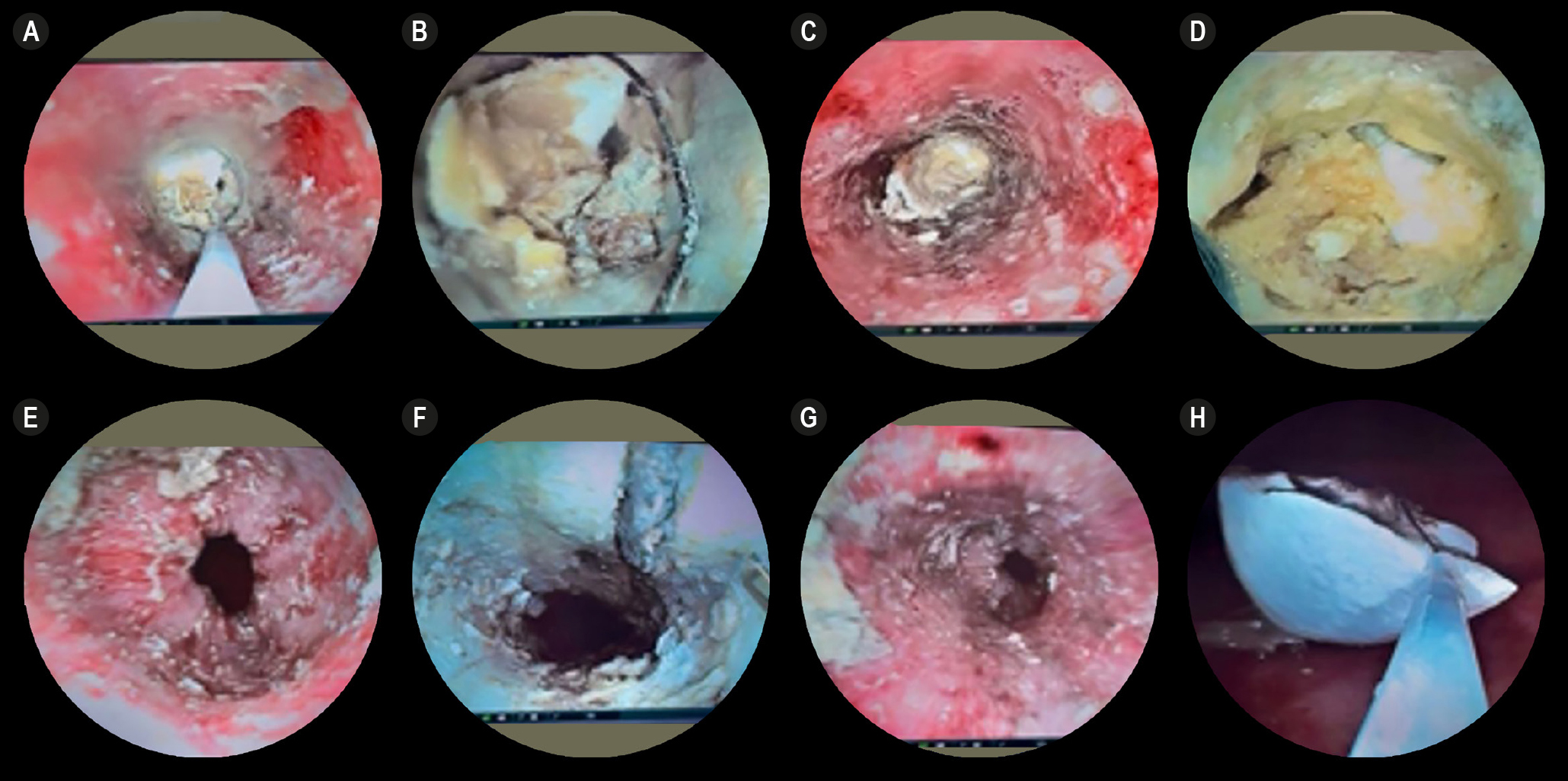
Case Report: The case of an adolescent with a history of ingestion of a solid caustic substance who developed severe esophageal injury with intraluminal impaction followed by early formation of a symptomatic stricture is described. Management included clinical follow-up, serial endoscopic and radiologic assessment, nutritional support, and progressive endoscopic dilation. During the clinical course, adjunctive therapies were considered to optimize the clinical response and reduce the risk of recurrence.
Conclusions: Esophageal stricture secondary to caustic injury represents a therapeutic challenge. Timely endoscopic dilation constitutes the cornerstone of treatment; however, its efficacy depends on the timing of initiation, the characteristics of the stricture, and early identification of factors associated with refractoriness, thereby allowing advanced interventions to be considered in a timely manner.
Downloads
References
Contini S, Scarpignato C. Caustic injury of the upper gastrointestinal tract: A comprehensive review. World J Gastroenterol. 2013;19(25):3918-30. https://doi.org/10.3748/wjg.v19.i25.3918
Millar AJW, Cox SG. Caustic injury of the oesophagus. Pediatr Surg Int. 2015;31(2):111-21. https://doi.org/10.1007/s00383-014-3642-3
Mamede RCM, De Mello Filho FV. Treatment of caustic ingestion: An analysis of 239 cases. Dis Esophagus. 2002;15(3):210-3. https://doi.org/10.1046/j.1442-2050.2002.00263.x
Dorterler ME, Günendi T. Foreign body and caustic substance ingestion in childhood. Open Access Emerg Med. 2020;12:341-52. https://doi.org/10.2147/OAEM.S241190
Zargar SA, Kochhar R, Nagi B, Mehta S, Mehta SK. Ingestion of corrosive acids. Spectrum of injury to upper gastrointestinal tract and natural history. Gastroenterology. 1989;97(3):702-7. https://doi.org/10.1016/0016-5085(89)90641-0
Oliva S, Romano C, De Angelis P, Isoldi S, Mantegazza C, Felici E, et al. Foreign body and caustic ingestions in children: A clinical practice guideline: Foreign Bodies and Caustic ingestions in children. Dig Liver Dis. 2020;52(11):1266-81. https://doi.org/10.1016/j.dld.2020.07.016
Gaudreault P, Parent M, McGuigan MA, Chicoine L, Lovejoy FH. Predictability of esophageal injury from signs and symptoms: A study of caustic ingestion in 378 children. Pediatrics. 1983;71(5):767-70. https://doi.org/10.1542/peds.71.5.767
Temiz A, Oguzkurt P, Ezer SS, Ince E, Hicsonmez A. Predictability of outcome of caustic ingestion by esophagogastroduodenoscopy in children. World J Gastroenterol. 2012;18(10):1098-103. https://doi.org/10.3748/wjg.v18.i10.1098
Coelho-Prabhu N, Forbes N, Thosani NC, Storm AC, Pawa S, Kohli DR, et al. Adverse events associated with EGD and EGD-related techniques. Gastrointest Endosc. 2022;96(3):389-401.e1. https://doi.org/10.1016/j.gie.2022.04.024
Cohen NA, Bettenworth D, Sror N, Khedraki R, Yang Q, Abreu MT, et al. Definitions, diagnosis, management, and outcomes of upper gastrointestinal Crohn’s disease: an international, expert RAND/UCLA appropriateness study. Lancet Gastroenterol Hepatol. 2026;11(3):243-255. https://doi.org/10.1016/S2468-1253(25)00347-4
Vermeulen BD, de Zwart M, Sijben J, Soons E, van der Weerd L, Arese D, et al. Risk factors and clinical outcomes of endoscopic dilation in benign esophageal strictures: a long-term follow-up study. Gastrointest Endosc. 2020;91(5):1058-66. https://doi.org/10.1016/j.gie.2019.12.040
Kochhar R, Poornachandra KS, Dutta U, Agrawal A, Singh K. Early endoscopic balloon dilation in caustic-induced gastric injury. Gastrointest Endosc. 2010;71(4):737-44. https://doi.org/10.1016/j.gie.2009.11.038
Grooteman KV, Wong Kee Song LM, Vleggaar FP, Siersema PD, Baron TH. Non-adherence to the rule of 3 does not increase the risk of adverse events in esophageal dilation. Gastrointest Endosc. 2017;85(2):332-337.e1. https://doi.org/10.1016/j.gie.2016.07.062
Chirica M, Kelly MD, Siboni S, Aiolfi A, Riva CG, Asti E, et al. Esophageal emergencies: WSES guidelines. World J Emerg Surg. 2019;14(1):25-6. https://doi.org/10.1186/s13017-019-0245-2
Usta M, Erkan T, Cokugras FC, Urganci N, Onal Z, Gulcan M, et al. High doses of methylprednisolone in the management of caustic esophageal burns. Pediatrics. 2014;133(6):E1518-24. https://doi.org/10.1542/peds.2013-3331
Barret M, Beye B, Leblanc S, Beuvon F, Chaussade S, Batteux F, et al. Systematic review: The prevention of oesophageal stricture after endoscopic resection. Aliment Pharmacol Ther. 2015;42(1):20-39. https://doi.org/10.1111/apt.13254
Randhawa FA, Butt NF, Talat SO, Sabir SH, Qamar MA. Effectiveness of intralesional steroid injections with dilatation in corrosive oesophageal strictures-a randomized control tiral. J Pak Med Assoc. 2018;68(11):1556-9.
Nijhawan S, Udawat HP, Nagar P. Aggressive bougie dilatation and intralesional steroids is effective in refractory benign esophageal strictures secondary to corrosive ingestion. Dis Esophagus. 2016;29(8):1027-31. https://doi.org/10.1111/dote.12438
Zaki RAM, El-Asmar KM, Amra HS, Elshafei EA, Bersy MA, Allam AM. Topical mitomycin C application versus intralesional corticosteroid injection in the management of caustic esophageal strictures in pediatrics: A randomized controlled trial. J Pediatr Surg. 2026;61(3):162884. https://doi.org/10.1016/j.jpedsurg.2025.162884
Chen H, Liu Y, Xu M, Guo R, Zhang J, Li M, et al. Long-Term Efficacy of Repeated Endoscopic Incision Combined with Triamcinolone Injection in Patients with Recurrent Benign Esophageal Stricture. Dig Dis Sci. 2025;70(9):3077-88. https://doi.org/10.1007/s10620-025-09101-z
Chirica M, Bonavina L, Kelly MD, Sarfati E, Cattan P. Caustic ingestion. Lancet. 2017;389(10083):2041-52. https://doi.org/10.1016/S0140-6736(16)30313-0
Fugazza A, Repici A. Endoscopic Management of Refractory Benign Esophageal Strictures. Dysphagia. 2021;36(3):504-16. https://doi.org/10.1007/s00455-021-10270-y
Chobarporn T, Mesiri D, Tharavej C. Endoscopic and surgical treatment of refractory caustic esophageal strictures. Surg Endosc. 2025;39(7):4513-24. https://doi.org/10.1007/s00464-025-11820-3
Le Naoures P, Hamy A, Lerolle N, Métivier E, Lermite E, Venara A. Risk factors for symptomatic esophageal stricture after caustic ingestion-A retrospective cohort study. Dis Esophagus. 2017;30(6):29207003. https://doi.org/10.1093/dote/dox029
Singh AK, Gunjan D, Dash NR, Poddar U, Gupta P, Jain AK, et al. Short-term and long-term management of caustic-induced gastrointestinal injury: An evidence-based practice guidelines. Indian J Gastroenterol. 2025;44(5):646-74. https://doi.org/10.1007/s12664-024-01692-1
Bruzzi M, Chirica M, Resche-Rigon M, Corte H, Voron T, Sarfati E, et al. Emergency Computed Tomography Predicts Caustic Esophageal Stricture Formation. Ann Surg. 2019;270(1):109-14. https://doi.org/10.1097/SLA.0000000000002732
Pasha SF, Acosta RD, Chandrasekhara V, Chathadi KV, Decker GA, Early DS, et al. The role of endoscopy in the evaluation and management of dysphagia. Gastrointest Endosc. 2014;79(2):191-201. https://doi.org/10.1016/j.gie.2013.07.042
Singh AK, Reddy YR, Jena A, Appasani S, Gupta P, Sinha SK, et al. Endoscopic dilation with bougies versus balloons in caustic esophageal strictures: 17-year experience from a tertiary care center. Surg Endosc. 2023;37(11):8236-44. https://doi.org/10.1007/s00464-023-10384-4
Joshi P, Yadav R, Dangi A, Kumar P, Kumar S, Gupta V, et al. Corrosive Esophageal Strictures: From Dilatation to Replacement: A Retrospective Cohort Study. Dysphagia. 2020;35(4):558-67. https://doi.org/10.1007/s00455-019-10058-1
Zhang YW, Wei FX, Qi XP, Liu Z, Xu XD, Zhang YC. Efficacy and Safety of Endoscopic Intralesional Triamcinolone Injection for Benign Esophageal Strictures. Gastroenterol Res Pract. 2018;2018:7619298. https://doi.org/10.1155/2018/7619298
Yang Y, Chen Y, Cai L, Qi J, Wang Z, Mo X. Analysis of Clinical Efficacy of Surgical Progressive Treatment for Corrosive Esophageal Stricture in Children. J Pediatr Surg. 2026;61(4):162891. https://doi.org/10.1016/j.jpedsurg.2025.162891
Papaconstantinou D, Katsaros I, Gkoutziotis I, Kechagias A, Tsamakis K, Ntikoudi E, et al. Corrosive ingestion-induced esophageal injuries: A systematic review and meta-analysis. Surg (United States). 2025;187:25-6. https://doi.org/10.1016/j.surg.2025.109658
Ajani JA, Barthel JS, Bentrem DJ, D’Amico TA, Das P, Denlinger CS, et al. Esophageal and esophagogastric junction cancers. JNCCN J Natl Compr Cancer Netw. 2011;9(8):830-87. https://doi.org/10.6004/jnccn.2011.0072
Raynaud K, Seguy D, Rogosnitzky M, Saulnier F, Pruvot FR, Zerbib P. Conservative management of severe caustic injuries during acute phase leads to superior long-term nutritional and quality of life (QoL) outcome. Langenbeck’s Arch Surg. 2016;401(1):81-7. https://doi.org/10.1007/s00423-015-1366-z
Downloads
Published
How to Cite
Issue
Section
License
Copyright (c) 2026 Revista colombiana de Gastroenterología

This work is licensed under a Creative Commons Attribution-NonCommercial-NoDerivatives 4.0 International License.
Aquellos autores/as que tengan publicaciones con esta revista, aceptan los términos siguientes:
Los autores/as ceden sus derechos de autor y garantizarán a la revista el derecho de primera publicación de su obra, el cuál estará simultáneamente sujeto a la Licencia de reconocimiento de Creative Commons que permite a terceros compartir la obra siempre que se indique su autor y su primera publicación en esta revista.
Los contenidos están protegidos bajo una licencia de Creative Commons Reconocimiento-NoComercial-SinObraDerivada 4.0 Internacional.


| Article metrics | |
|---|---|
| Abstract views | 2 |
| Galley views | 0 |
| PDF Views | 0 |
| HTML views | 0 |
| Other views | 0 |