Malabsorption beyond allergy: Two cases of primary exocrine pancreatic insufficiency in children
DOI:
https://doi.org/10.22516/25007440.1541Keywords:
Exocrine pancreatic insufficiency, infant, preschool child, malabsorption syndromesAbstract
Introduction: Exocrine pancreatic insufficiency is an uncommon condition in the pediatric population. It may be hereditary (primary) or acquired (secondary), with cystic fibrosis accounting for most cases.
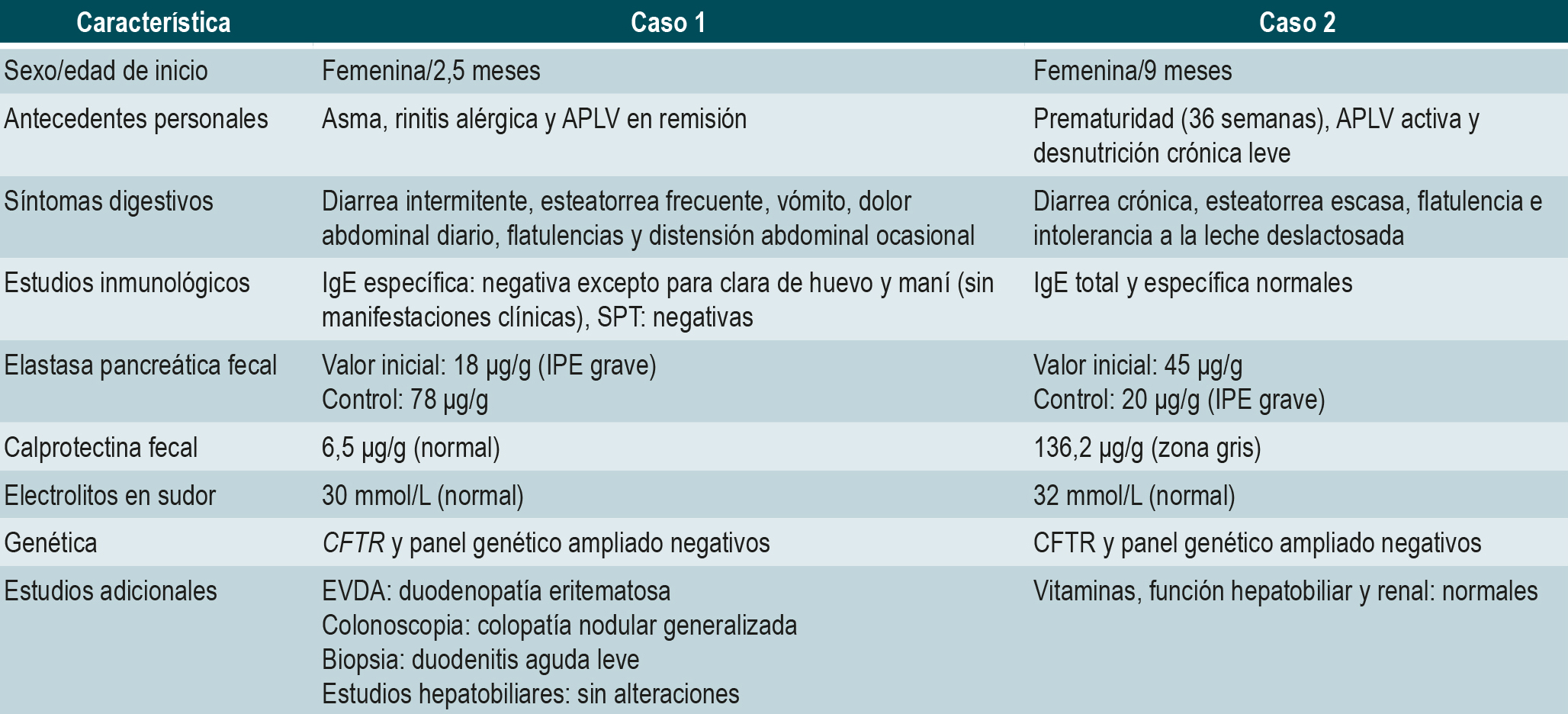
Case Reports: Two cases of idiopathic exocrine pancreatic insufficiency in pediatric patients are reported. Both patients presented at an early age with persistent gastrointestinal symptoms, predominantly suggestive of malabsorption. An initial diagnosis of cow’s milk protein allergy was established by challenge testing; however, both patients subsequently outgrew the condition. During the diagnostic workup, which included multiple investigations, fecal pancreatic elastase levels were found to be decreased in both cases, confirming the diagnosis of exocrine pancreatic insufficiency. Treatment with pancreatic enzymes, fat-soluble vitamins, and nutritional supplementation was initiated, resulting in progressive and sustained improvement in symptoms, food tolerance, and quality of life for both patients and their families.
Discussion: Exocrine pancreatic insufficiency is an uncommon condition in children, and its diagnosis represents a clinical challenge. It is therefore important to maintain a high index of suspicion in patients with chronic gastrointestinal symptoms and impaired nutritional status, particularly when initial investigations do not clearly account for the clinical presentation and in the absence of comorbidities such as cystic fibrosis, as observed in the patients described herein. The diagnosis can be established by measuring fecal pancreatic elastase, which has high specificity and is widely available in our setting.
Conclusion: Early diagnosis of exocrine pancreatic insufficiency enables timely initiation of treatment and contributes to improved clinical outcomes and quality of life for affected patients and their families.
Downloads
References
Tian C, Ghodeif AO, Arshad S, Gillespie E. Exocrine pancreatic insufficiency. In: StatPearls. Treasure Island (FL): StatPearls Publishing; 2025.
Kleinman RE, Goulet OJ, Mieli-Vergani G, Sanderson IR, Sherman PM. Walker’s Pediatric Gastrointestinal Disease: Pathology, Diagnosis, Management. 6.a edición. Hamilton (ON): BC Decker; 2018.
Martín-Ruiz JL, Diéguez-Castillo C, Jiménez-Luna C, Prados J, Caba O. Estado del arte en la insuficiencia pancreática exocrina. Medicina (Kaunas). 2020;56(10):523. https://doi.org/10.3390/medicina56100523
Sankararaman S, Schindler T. Exocrine pancreatic insufficiency in children: challenges in management. Pediatr Health Med Ther. 2023;14:361-73. https://doi.org/10.2147/PHMT.S402589
Sankararaman S, Schindler T, Sferra TJ. Management of exocrine pancreatic insufficiency in children. Nutr Clin Pract. 2019;34(suppl 1):S27-S42. https://doi.org/10.1002/ncp.10388
Yuzyuk TN, Nelson HA, Johnson LM. Inherited causes of exocrine pancreatic insufficiency in pediatric patients: clinical presentation and laboratory testing. Crit Rev Clin Lab Sci. 2023;60(5):366-81. https://doi.org/10.1080/10408363.2023.2179968
Scheers I, Berardis S. Congenital etiologies of exocrine pancreatic insufficiency. Front Pediatr. 2022;10:909925. https://doi.org/10.3389/fped.2022.909925
Vanga RR, Tansel A, Sidiq S, El-Serag HB, Othman M. Diagnostic performance of measurement of fecal elastase-1 in detection of exocrine pancreatic insufficiency: a systematic review and meta-analysis. Clin Gastroenterol Hepatol. 2018;16(8):1220-1228.e4. https://doi.org/10.1016/j.cgh.2018.01.027
Vujasinovic M, Dominguez-Muñoz JE, Löhr JM. Mistakes in pancreatic exocrine insufficiency and how to avoid them. UEG Education. 2026;26:1-4.
Patel N, Sellers ZM, Grover A, Liu QY, Maqbool A, Morinville VD, et al. Endoscopic pancreatic function testing (ePFT) in children: a position paper from the NASPGHAN Pancreas Committee. J Pediatr Gastroenterol Nutr. 2021;72(1):144-50. https://doi.org/10.1097/MPG.0000000000002931
Iglesia D, Vujasinovic M, Löhr JM, Dominguez-Muñoz JE. Pancreatic exocrine insufficiency. EClinicalMedicine. 2026;94:103880. https://doi.org/10.1016/j.eclinm.2026.103880
Downloads
Published
How to Cite
Issue
Section
License
Copyright (c) 2026 Revista colombiana de Gastroenterología

This work is licensed under a Creative Commons Attribution-NonCommercial-NoDerivatives 4.0 International License.
Aquellos autores/as que tengan publicaciones con esta revista, aceptan los términos siguientes:
Los autores/as ceden sus derechos de autor y garantizarán a la revista el derecho de primera publicación de su obra, el cuál estará simultáneamente sujeto a la Licencia de reconocimiento de Creative Commons que permite a terceros compartir la obra siempre que se indique su autor y su primera publicación en esta revista.
Los contenidos están protegidos bajo una licencia de Creative Commons Reconocimiento-NoComercial-SinObraDerivada 4.0 Internacional.


| Article metrics | |
|---|---|
| Abstract views | 3 |
| Galley views | 0 |
| PDF Views | 0 |
| HTML views | 0 |
| Other views | 0 |