Trastornos anorrectales de la interacción intestino-cerebro según Roma V
DOI:
https://doi.org/10.22516/25007440.1626Palavras-chave:
Incontinencia fecal, estreñimiento, defecación, manometríaResumo
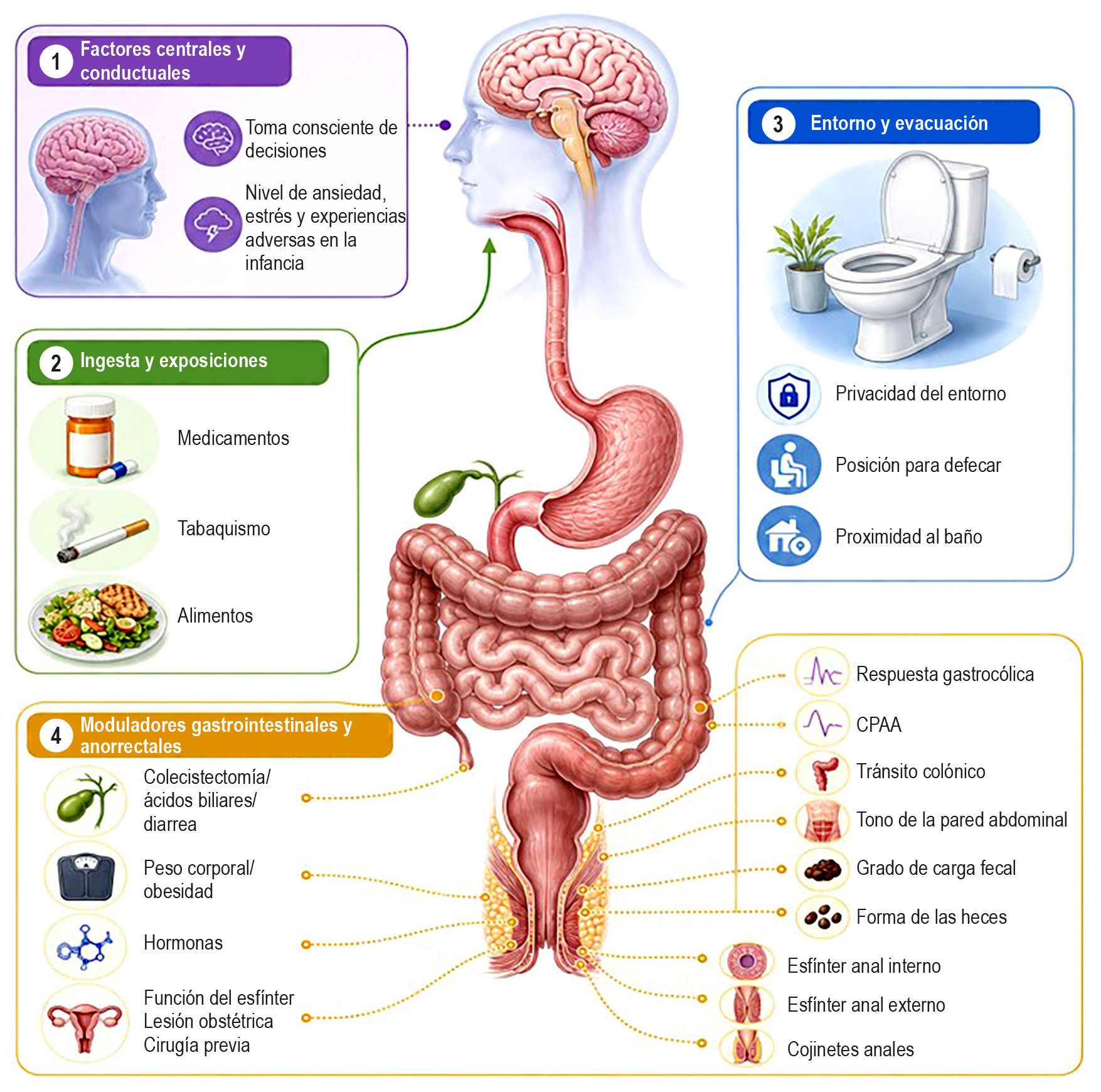
Introducción: los trastornos anorrectales son frecuentes, afectan de manera sustancial la calidad de vida y pueden resultar de alteraciones motoras, sensitivas, estructurales y conductuales que suelen coexistir. La actualización de Roma V busca vincular con mayor precisión los síntomas con la fisiopatología y las pruebas funcionales.
Resultados: esta revisión resume los cambios clínicamente relevantes de Roma V en incontinencia fecal, síndromes de dolor anorrectal, defecación disinérgica y trastornos de sensibilidad rectal. Cada entidad se presenta de forma narrativa, con la definición, epidemiología, fisiopatología, diagnóstico y tratamiento, seguida de un apartado específico sobre los cambios introducidos por Roma V. La incontinencia fecal y el dolor anorrectal se continúan definiendo principalmente por sus manifestaciones clínicas y la exclusión de causas orgánicas. En la defecación disinérgica, Roma V amplía el espectro sintomático y permite documentar la evacuación alterada mediante manometría anorrectal, prueba de expulsión con balón o defecografía, siempre con valores normales apropiados para la técnica. Una innovación mayor es el reconocimiento de la hiposensibilidad y la hipersensibilidad rectales como categorías diagnósticas.
Conclusiones: Roma V propone una clasificación más fisiopatológica y operativa. Su aplicación exige interpretar los hallazgos funcionales en el contexto clínico y evitar atribuir la causalidad a anomalías aisladas.
Downloads
Referências
Bharucha AE, Rao SSC. An update on anorectal disorders for gastroenterologists. Gastroenterology. 2014;146(1):37-45.e2. https://doi.org/10.1053/j.gastro.2013.10.062
Rao SSC, Bharucha AE, Carrington EV, Grossi U, Malcolm A, Neshatian L, Remes-Troche JM. Anorectal disorders. Gastroenterology. 2026;170(6):1318-1346. https://doi.org/10.1053/j.gastro.2026.01.037
Carrington EV, Heinrich H, Knowles CH, Fox M, Rao SSC, Altomare DF, et al. The International Anorectal Physiology Working Group recommendations: standardized testing protocol and the London classification for disorders of anorectal function. Neurogastroenterol Motil. 2020;32(1):e13679. https://doi.org/10.1111/nmo.13679
Mack I, Hahn H, Gödel C, Enck P, Bharucha AE. Global prevalence of fecal incontinence in community-dwelling adults: a systematic review and meta-analysis. Clin Gastroenterol Hepatol. 2024;22(4):712-731.e8. https://doi.org/10.1016/j.cgh.2023.09.004
Bharucha AE, Zinsmeister AR, Schleck CD, Melton LJ 3rd. Bowel disturbances are the most important risk factors for late-onset fecal incontinence: a population-based case-control study in women. Gastroenterology. 2010;139(5):1559-1566. https://doi.org/10.1053/j.gastro.2010.07.056
Bharucha AE, Basilisco G, Malcolm A, Lee TH, Hoy MB, Scott SM, et al. Review of the indications, methods, and clinical utility of anorectal manometry and the rectal balloon expulsion test. Neurogastroenterol Motil. 2022;34(9):e14335. https://doi.org/10.1111/nmo.14335
Heymen S, Scarlett Y, Jones K, Ringel Y, Drossman D, Whitehead WE. Randomized controlled trial shows biofeedback to be superior to pelvic floor exercises for fecal incontinence. Dis Colon Rectum. 2009;52(10):1730-1737. https://doi.org/10.1007/DCR.0b013e3181b55455
Hull T, Giese C, Wexner SD, Mellgren A, Devroede G, Madoff RD, et al. Long-term durability of sacral nerve stimulation therapy for chronic fecal incontinence. Dis Colon Rectum. 2013;56(2):234-245. https://doi.org/10.1097/DCR.0b013e318276b24c
Rao SSC, Bharucha AE, Chiarioni G, Felt-Bersma R, Knowles C, Malcolm A, et al. Functional anorectal disorders. Gastroenterology. 2016;150(6):1430-1442.e4. https://doi.org/10.1053/j.gastro.2016.02.009
Chiarioni G, Nardo A, Vantini I, Romito A, Whitehead WE. Biofeedback is superior to electrogalvanic stimulation and massage for treatment of levator ani syndrome. Gastroenterology. 2010;138(4):1321-1329. https://doi.org/10.1053/j.gastro.2009.12.040
Yan Y, Erdogan A, Adame EC, Rao SSC. Pathoetiology of levator ani syndrome and its treatment with translumbosacral neuromodulation therapy. Am J Gastroenterol. 2023;118(12):2242-2246. https://doi.org/10.14309/ajg.0000000000002394
Rao SSC, Paulson J, Mata M, Zimmerman B. Clinical trial: effects of botulinum toxin on levator ani syndrome - a double-blind, placebo-controlled study. Aliment Pharmacol Ther. 2009;29(9):985-991. https://doi.org/10.1111/j.1365-2036.2009.03964.x
Eckardt VF, Dodt O, Kanzler G, Bernhard G. Treatment of proctalgia fugax with salbutamol inhalation. Am J Gastroenterol. 1996;91(4):686-689.
Rao SSC, Tuteja AK, Vellema T, Kempf J, Stessman M. Dyssynergic defecation: demographics, symptoms, stool patterns, and quality of life. J Clin Gastroenterol. 2004;38(8):680-685. https://doi.org/10.1097/01.mcg.0000135929.78074.8c
Ratuapli SK, Bharucha AE, Noelting J, Harvey DM, Zinsmeister AR. Phenotypic identification and classification of functional defecatory disorders using high-resolution anorectal manometry. Gastroenterology. 2013;144(2):314-322.e2. https://doi.org/10.1053/j.gastro.2012.10.049
Grossi U, Carrington EV, Bharucha AE, Horrocks EJ, Scott SM, Knowles CH. Diagnostic accuracy study of anorectal manometry for diagnosis of dyssynergic defecation. Gut. 2016;65(3):447-455. https://doi.org/10.1136/gutjnl-2014-308835
Blackett JW, Gautam M, Mishra R, Oblizajek NR, Ramu SK, Bailey KR, et al. Comparison of anorectal manometry, rectal balloon expulsion test, and defecography for diagnosing defecatory disorders. Gastroenterology. 2022;163(6):1582-1592.e2. https://doi.org/10.1053/j.gastro.2022.08.034
Videlock EJ, Lembo A, Cremonini F. Diagnostic testing for dyssynergic defecation in chronic constipation: meta-analysis. Neurogastroenterol Motil. 2013;25(6):509-520. https://doi.org/10.1111/nmo.12096
Rao SSC, Benninga MA, Bharucha AE, Chiarioni G, Di Lorenzo C, Whitehead WE. ANMS-ESNM position paper and consensus guidelines on biofeedback therapy for anorectal disorders. Neurogastroenterol Motil. 2015;27(5):594-609. https://doi.org/10.1111/nmo.12520
Chiarioni G, Salandini L, Whitehead WE. Biofeedback benefits only patients with outlet dysfunction, not patients with isolated slow transit constipation. Gastroenterology. 2005;129(1):86-97. https://doi.org/10.1053/j.gastro.2005.05.015
Rao SSC, Valestin JA, Xiang X, Hamdy S, Bradley CS, Zimmerman MB. Home-based versus office-based biofeedback therapy for constipation with dyssynergic defecation: a randomised controlled trial. Lancet Gastroenterol Hepatol. 2018;3(11):768-777. https://doi.org/10.1016/S2468-1253(18)30266-8
Rao SSC, Valestin J, Brown CK, Zimmerman B, Schulze K. Long-term efficacy of biofeedback therapy for dyssynergic defecation: randomized controlled trial. Am J Gastroenterol. 2010;105(4):890-896. https://doi.org/10.1038/ajg.2010.53
Mazor Y, Trieu RQ, Prott G, Jones M, Ejova A, Kellow J, et al. Volumetric rectal perception testing: is it clinically relevant? Results from a large patient cohort. Am J Gastroenterol. 2021;116(12):2419-2429. https://doi.org/10.14309/ajg.0000000000001526
Vollebregt PF, Burgell RE, Hooper RL, Knowles CH, Scott SM. Clinical impact of rectal hyposensitivity: a cross-sectional study of 2,876 patients with refractory functional constipation. Am J Gastroenterol. 2021;116(4):758-768. https://doi.org/10.14309/ajg.0000000000001039
Gladman MA, Aziz Q, Scott SM, Williams NS, Lunniss PJ. Rectal hyposensitivity: pathophysiological mechanisms. Neurogastroenterol Motil. 2009;21(5):508-516, e4-e5. https://doi.org/10.1111/j.1365-2982.2008.01216.x
Carrington EV, Scott SM, Bharucha A, Mion F, Remes-Troche JM, Malcolm A, et al. Advances in the evaluation of anorectal function. Nat Rev Gastroenterol Hepatol. 2018;15(5):309-323. https://doi.org/10.1038/nrgastro.2018.27
Rao SSC, Yan Y, Erdogan A, Coss-Adame E, Patcharatrakul T, Valestin J, et al. Barostat or syringe-assisted sensory biofeedback training for constipation with rectal hyposensitivity: a randomized controlled trial. Neurogastroenterol Motil. 2022;34(3):e14226. https://doi.org/10.1111/nmo.14226
Rao SSC, Coss-Adame E, Yan Y, Erdogan A, Valestin J, Ayyala DN. Sensory adaptation training or escitalopram for IBS with constipation and rectal hypersensitivity: a randomized controlled trial. Clin Transl Gastroenterol. 2021;12(7):e00381. https://doi.org/10.14309/ctg.0000000000000381
Downloads
Publicado
Como Citar
Edição
Seção
Licença
Copyright (c) 2026 Revista colombiana de Gastroenterologia

Este trabalho está licenciado sob uma licença Creative Commons Attribution-NonCommercial-NoDerivatives 4.0 International License.
Aquellos autores/as que tengan publicaciones con esta revista, aceptan los términos siguientes:
Los autores/as ceden sus derechos de autor y garantizarán a la revista el derecho de primera publicación de su obra, el cuál estará simultáneamente sujeto a la Licencia de reconocimiento de Creative Commons que permite a terceros compartir la obra siempre que se indique su autor y su primera publicación en esta revista.
Los contenidos están protegidos bajo una licencia de Creative Commons Reconocimiento-NoComercial-SinObraDerivada 4.0 Internacional.


| Métricas do artigo | |
|---|---|
| Vistas abstratas | 2 |
| Visualizações da cozinha | 0 |
| Visualizações de PDF | 0 |
| Visualizações em HTML | 0 |
| Outras visualizações | 0 |