Beyond adenocarcinoma: Pancreatic adenoescamotic carcinoma, rare case report
DOI:
https://doi.org/10.22516/25007440.1481Keywords:
Pancreatic neoplasms, endoscopic ultrasonography, elderly, biopsy, case reportsAbstract
Introduction: Pancreatic adenosquamous carcinoma is an uncommon exocrine neoplasm that represents between 1% and 4% of pancreatic tumors. It is characterized by the presence of glandular and squamous components and is associated with highly aggressive behavior and poor prognosis. Diagnosis usually occurs at advanced stages because of its nonspecific clinical presentation and rapid progression.
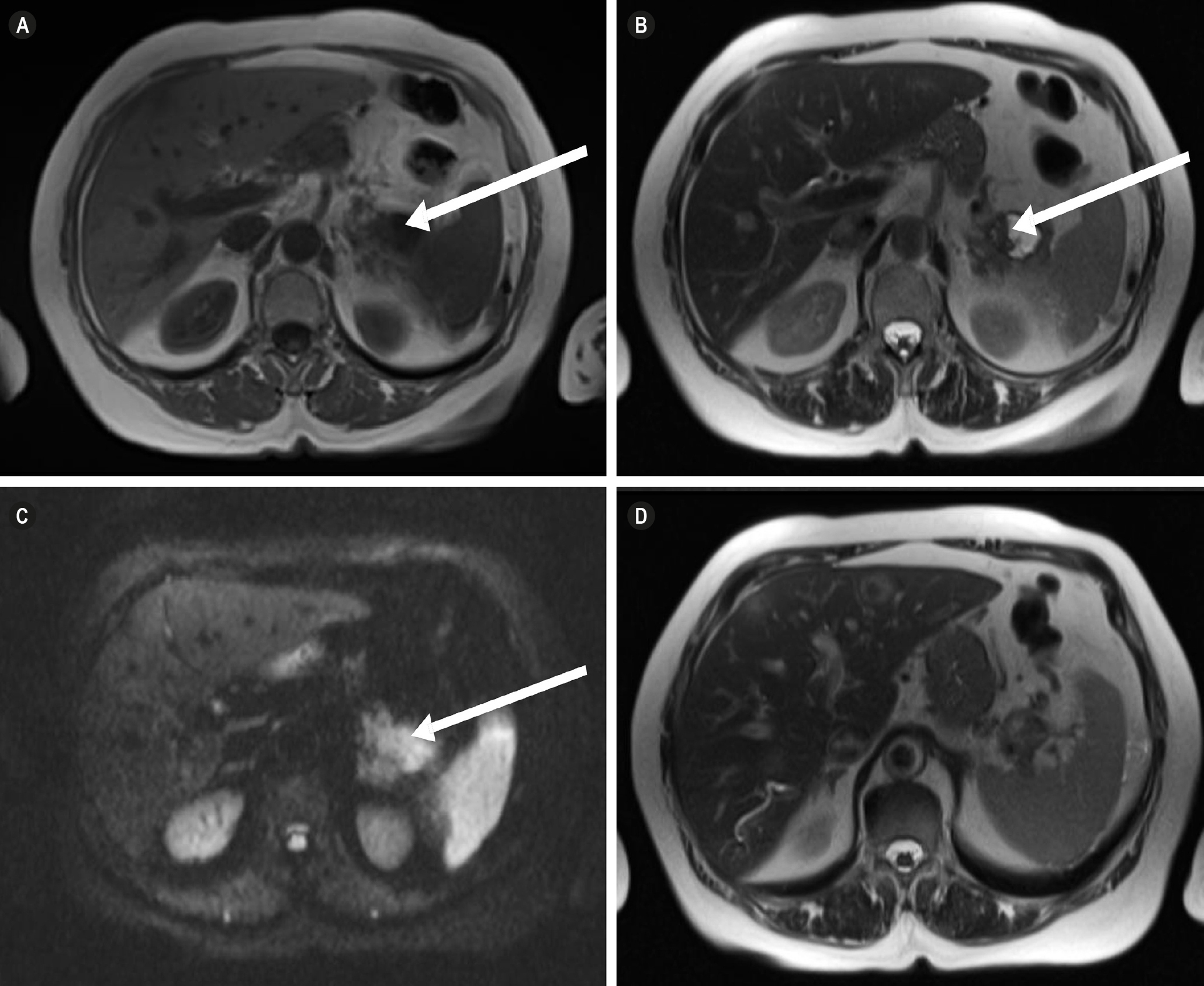
Case presentation: We present the case of an 82-year-old female patient with abdominal pain, jaundice, and constitutional syndrome. Laboratory studies showed cholestasis, cytolysis, and direct hyperbilirubinemia. Computed tomography and abdominal magnetic resonance imaging showed a solid-cystic lesion in the tail of the pancreas with involvement of adjacent structures and multiple liver lesions suggestive of metastases. Endoscopic ultrasound with biopsy confirmed the diagnosis of adenosquamous carcinoma through histopathological and immunohistochemical studies (p63 positive in the squamous component and carcinoembryonic antigen positive in the glandular component). The patient had an unfavorable clinical course and died two months after diagnosis.
Discussion: This tumor subtype is associated with a high rate of early dissemination, lymphovascular invasion, and perineural invasion, which limits therapeutic options. Although surgical resection is the treatment of choice in early stages, most cases are unresectable at diagnosis. No standardized chemotherapy regimen exists, reflecting the limited available evidence.
Conclusion: Pancreatic adenosquamous carcinoma is a rare entity with a poor prognosis, and its timely recognition and histological confirmation are essential. Additional studies are required to optimize its diagnostic and therapeutic approach, consultation, and information at the time of managing this pathology, as it is rare and poorly known.
Downloads
References
Moslim MA, Lefton MD, Ross EA, Mackrides N, Reddy SS. Clinical and Histological Basis of Adenosquamous Carcinoma of the Pancreas: A 30-year Experience. J Surg Res. 2021;259:350-356. https://doi.org/10.1016/j.jss.2020.09.024
Kwak HV, Hsu DS, Chang A, Kazantsev GB, Peng PD, Spitzer AL, et al. Pancreatic Adenosquamous Carcinoma: Experience Within an Integrated Health Care System. Perm J. 2023;27(2):9-12. https://doi.org/10.7812/TPP/22.095
Limaiem F, Hajri M, Ben Farhat L. Adenosquamous carcinoma of the pancreas: A rare and aggressive variant of pancreatic cancer. Clin Case Rep. 2022;10(8):e6181. https://doi.org/10.1002/ccr3.6181
Boyd CA, Benarroch-Gampel J, Sheffield KM, Cooksley CD, Riall TS. 415 Patients with adenosquamous carcinoma of the pancreas: A population-based analysis of prognosis and survival. J Surg Res. 2012;174(1):12-9. https://doi.org/10.1016/j.jss.2011.06.015
Paramythiotis D, Kyriakidis F, Karlafti E, Didangelos T, Oikonomou IM, Karakatsanis A, et al. Adenosquamous carcinoma of the pancreas: two case reports and review of the literature. J Med Case Rep. 2022;16(1):395. https://doi.org/10.1186/s13256-022-03610-5
Szekely TB, Toganel C, Kadar Z, Sava AD, Bara T, Roman D, et al. Adenosquamous and squamous cell carcinoma of the pancreas: two histopathological variants of ductal adenocarcinoma. Acta Marisiensis Seria Medica. 2021;67(3):173-6. https://doi.org/10.2478/amma-2021-0025
Xiong Q, Zhang Z, Xu Y, Zhu Q. Pancreatic Adenosquamous Carcinoma: A Rare Pathological Subtype of Pancreatic Cancer. J Clin Med. 2022;11(24):7401. https://doi.org/10.3390/jcm11247401
Braun R, Klinkhammer-Schalke M, Zeissig SR, Kleihus van Tol K, Bolm L, Honselmann KC, et al. Clinical Outcome and Prognostic Factors of Pancreatic Adenosquamous Carcinoma Compared to Ductal Adenocarcinoma-Results from the German Cancer Registry Group. Cancers (Basel). 2022;14(16):3946. https://doi.org/10.3390/cancers14163946
de Jesus VHF, Donadio MDS, de Brito ÂBC, Gentilli AC. A narrative review on rare types of pancreatic cancer: should they be treated as pancreatic ductal adenocarcinomas? Ther Adv Med Oncol. 2024;16:17588359241265213. https://doi.org/10.1177/17588359241265213
Yoshida Y, Kobayashi S, Ueno M, Morizane C, Tsuji K, Maruki Y, et al. Efficacy of chemotherapy for patients with metastatic or recurrent pancreatic adenosquamous carcinoma: A multicenter retrospective analysis. Pancreatology. 2022;22(8):1159-1166. https://doi.org/10.1016/j.pan.2022.09.236
Sakakida T, Ishikawa T, Doi T, Morita R, Kataoka S, Miyake H, et al. Genomic landscape and clinical features of rare subtypes of pancreatic cancer: analysis with the national database of Japan. J Gastroenterol. 2023;58(6):575-585. https://doi.org/10.1007/s00535-023-01986-9
Walsh AK, Tsilimigras DI, Blair AB, Tsai S, Pawlik TM, Manne A, et al. Role of Neoadjuvant Therapy for Patients with Adenosquamous Carcinoma of the Pancreas: Outcomes from the National Cancer Database. J Gastrointest Cancer. 2025;56(1):145. https://doi.org/10.1007/s12029-025-01269-x
Zhang W, Zhang J, Liang X, Ding J. Research advances and treatment perspectives of pancreatic adenosquamous carcinoma. Cell Oncol (Dordr). 2023;46(1):1-15. https://doi.org/10.1007/s13402-022-00732-2
Downloads
Published
How to Cite
Issue
Section
License
Copyright (c) 2026 Revista colombiana de Gastroenterología

This work is licensed under a Creative Commons Attribution-NonCommercial-NoDerivatives 4.0 International License.
Aquellos autores/as que tengan publicaciones con esta revista, aceptan los términos siguientes:
Los autores/as ceden sus derechos de autor y garantizarán a la revista el derecho de primera publicación de su obra, el cuál estará simultáneamente sujeto a la Licencia de reconocimiento de Creative Commons que permite a terceros compartir la obra siempre que se indique su autor y su primera publicación en esta revista.
Los contenidos están protegidos bajo una licencia de Creative Commons Reconocimiento-NoComercial-SinObraDerivada 4.0 Internacional.


| Article metrics | |
|---|---|
| Abstract views | 16 |
| Galley views | 2 |
| PDF Views | 2 |
| HTML views | 0 |
| Other views | 0 |