Phantom tumor in an older adult with decompensated MASLD-related cirrhosis: A case report
DOI:
https://doi.org/10.22516/25007440.1457Keywords:
Hepatic cirrhosis, pleural effusion, diagnostic imagingAbstract
Introduction: Phantom tumors are localized collections of pleural fluid within the interlobar fissures that mimic pulmonary masses on imaging studies. This phenomenon has been attributed to diaphragmatic defects or pleural adhesions and is observed primarily in the setting of heart or renal failure, hypoalbuminemia, or hepatic cirrhosis. Its occurrence in cirrhosis is exceptionally rare.
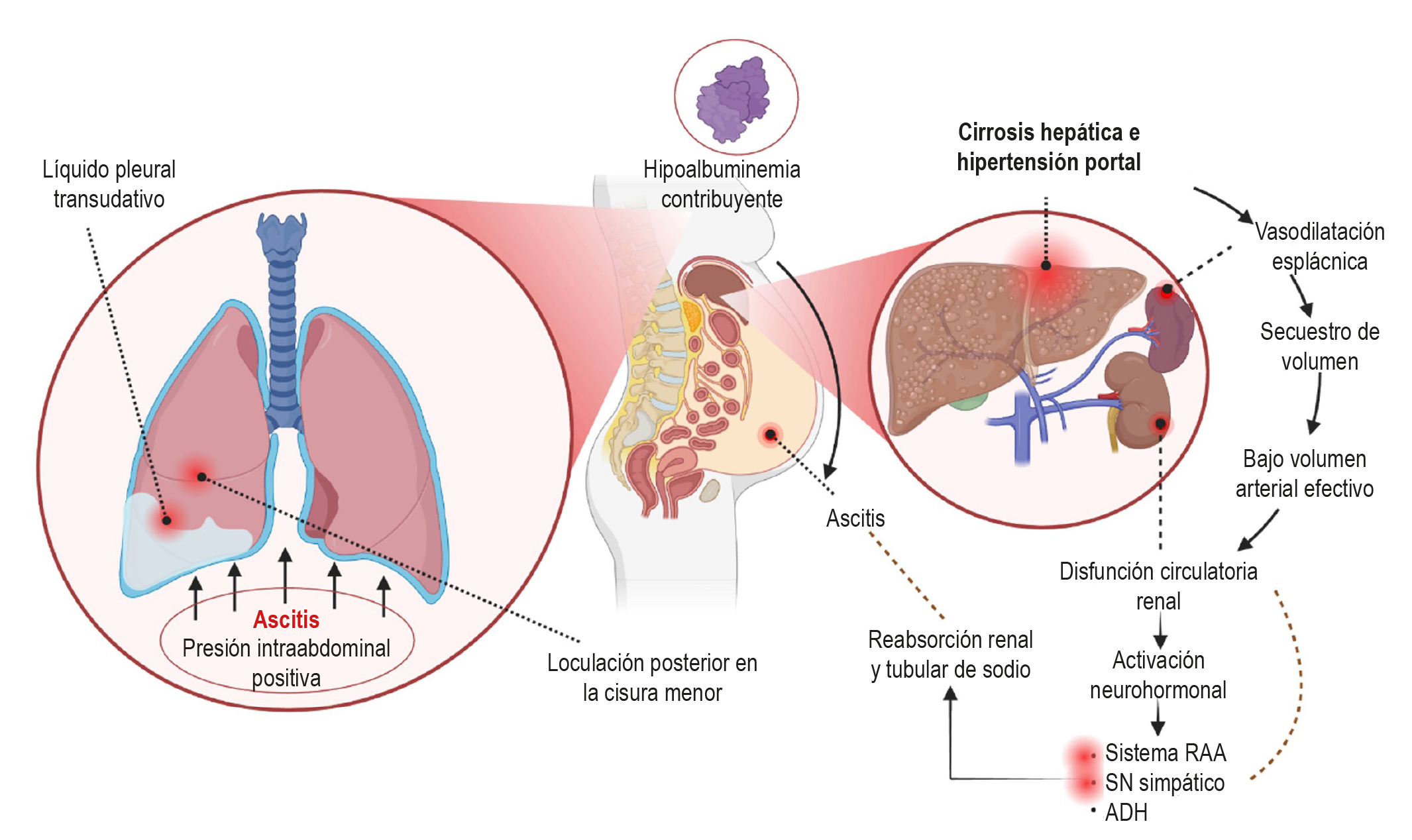
Case Report: A 65-year-old woman with cirrhosis secondary to metabolic dysfunction–associated steatotic liver disease (Child-Pugh class C, MELD-Na score 29) was admitted with general deterioration, abdominal distention, and dyspnea. Stage 3 acute kidney injury consistent with hepatorenal syndrome–acute kidney injury was identified. Paracentesis confirmed portal hypertensive ascites (serum-ascites albumin gradient, 2.23 g/dL) without evidence of infection. Hepatocellular carcinoma was ruled out (negative alpha-fetoprotein), as was heart failure (normal echocardiogram; left ventricular ejection fraction, 58%).
Results: Chest radiography revealed an image suggestive of a mass in the right minor fissure. Thoracentesis yielded a transudative effusion consistent with hepatic hydrothorax. Following drainage with a pigtail catheter, follow-up chest radiography demonstrated complete resolution of the lesion, confirming a phantom tumor.
Conclusion: Phantom tumor is an uncommon manifestation of cirrhosis and may mimic malignant lesions. Recognition of this entity through clinical assessment, pleural fluid analysis, and radiographic follow-up can prevent unnecessary invasive procedures and confirm its transient nature.
Downloads
References
Stewart HJ. Pleural effusion localized in an interlobar space: report of a case of heart failure together with autopsy. Am Heart J. 1928;4(2):227–35. https://doi.org/10.1016/S0002-8703(28)90073-3
Pagès AL, Tarragó RF, Serralta AM. Tumor fantasma. FMC. 2010;17(7):501-2.
Ocampo-Chaparro JM, Urrea-Zapata JK, Gutiérrez-Londoño H, Jurado-Delgado J, Uribe-Valencia M. Tumor evanescente: un reto diagnóstico. Rev Colomb Cardiol. 2018;25(2):153-55. https://doi.org/10.1016/j.rccar.2017.08.023
Ocampo-Chaparro JM, Reyes-Ortiz CA, Etayo-Ruiz E. Valoración geriátrica integral en cuidados paliativos: revisión bibliográfica. Med Paliat. 2021;28(3):185-97. https://doi.org/10.20986/medpal.2021.1163/2020
Orman ES, Fortune BE, John BV, Asrani SK. AGA Clinical Practice Update on the Management of Ascites, Volume Overload, and Hyponatremia in Cirrhosis: Expert Review. Gastroenterology. 2025;169(7):1547-57. https://doi.org/10.1053/j.gastro.2025.08.029
Nadim MK, Garcia-Tsao G. Acute kidney injury in patients with cirrhosis. N Engl J Med. 2023;388(8):733-45. https://doi.org/10.1056/NEJMra2215289
Ostermann M, Lumlertgul N, Jeong R, See E, Joannidis M, James M. Acute kidney injury. Lancet. 2025;405(10474):241-56. https://doi.org/10.1016/S0140-6736(24)02385-7
Karvellas CJ, Bajaj JS, Kamath PS, Napolitano L, O’Leary JG, Solà E, et al. AASLD practice guidance on acute-on-chronic liver failure and the management of critically ill patients with cirrhosis. Hepatology. 2024;79(6):1463-1502. https://doi.org/10.1097/HEP.0000000000000671
Biggins SW, Angeli P, Garcia-Tsao G, Ginès P, Ling SC, Nadim MK, et al. Diagnosis, evaluation, and management of ascites, spontaneous bacterial peritonitis and hepatorenal syndrome: 2021 practice guidance by the American Association for the Study of Liver Diseases. Hepatology. 2021;74(2):1014-48. https://doi.org/10.1002/hep.31884
National Comprehensive Cancer Network. Hepatocellular carcinoma. NCCN Clinical Practice Guidelines in Oncology. Version 2.2025. Plymouth Meeting (PA): National Comprehensive Cancer Network; 2025.
Sah A, Derakhshesh MI, Bozell HD, Wasim M, Javed F, Kirkpatrick P, et al. Diagnostic accuracy of echocardiography in identifying heart failure related pleural effusions. Respir Med. 2026;252:108627. https://doi.org/10.1016/j.rmed.2025.108627
Sundaralingam A, Grabczak EM, Burra P, Costa MI, George V, Harriss E, et al. ERS statement on benign pleural effusions in adults. Eur Respir J. 2024;64(6):2302307. https://doi.org/10.1183/13993003.02307-2023
Cilia BJ, Haridy J, Raj A, Hannah N. Hepatic Hydrothorax as a Manifestation of Decompensated Cirrhosis: An Update on Current Management and Future Directions. World J Hepatol. 2025;17(10):110412. https://doi.org/10.4254/wjh.v17.i10.110412
Wei N. Hypoalbuminemia contributes to ascites formation via sodium and water retention: evidence from clinical data and albumin-deficient mice. Biochim Biophys Acta Mol Basis Dis. 2024;1870(6):167275. https://doi.org/10.1016/j.bbadis.2024.167275
Molino Trinidad C, Solá Pascual P, Boyé de la Presa R, Tamargo Fernández E. Tumor fantasma [Phantom tumor (author’s transl)]. Med Clin (Barc). 1979;73(3):109-13.
Weiss W, Boucot KR, Gefter WI. Localized interlobar effusion in congestive heart failure. Ann Intern Med. 1953;38(6):1177-86. https://doi.org/10.7326/0003-4819-38-6-1177
Martínez-Molina JA, Martínez-González MA, Vives-Santacana M, Gonzalez-Delgado AD, Reviejo-Jaka K, Monedero P. Comparación diagnóstica de la ecografía pulmonar abreviada a pie de cama y la radiografía de tórax en la unidad de cuidados intensivos. An Sist Sanit Navar 2024; 47(3): e1088. https://doi.org/10.23938/assn.1088
Badillo R, Rockey DC. Hepatic hydrothorax: clinical features, management, and outcomes in 77 patients and review of the literature. Medicine (Baltimore). 2014;93(3):135-42. https://doi.org/10.1097/MD.0000000000000025
Wilkins H, Britt E, Bhatnagar M, Pippard B. Hepatic hydrothorax. J Thorac Dis. 2024;16(2):1662-73. https://doi.org/10.21037/jtd-23-1649
Downloads
Published
How to Cite
Issue
Section
License
Copyright (c) 2026 Revista colombiana de Gastroenterología

This work is licensed under a Creative Commons Attribution-NonCommercial-NoDerivatives 4.0 International License.
Aquellos autores/as que tengan publicaciones con esta revista, aceptan los términos siguientes:
Los autores/as ceden sus derechos de autor y garantizarán a la revista el derecho de primera publicación de su obra, el cuál estará simultáneamente sujeto a la Licencia de reconocimiento de Creative Commons que permite a terceros compartir la obra siempre que se indique su autor y su primera publicación en esta revista.
Los contenidos están protegidos bajo una licencia de Creative Commons Reconocimiento-NoComercial-SinObraDerivada 4.0 Internacional.


| Article metrics | |
|---|---|
| Abstract views | 1 |
| Galley views | 0 |
| PDF Views | 0 |
| HTML views | 0 |
| Other views | 0 |